








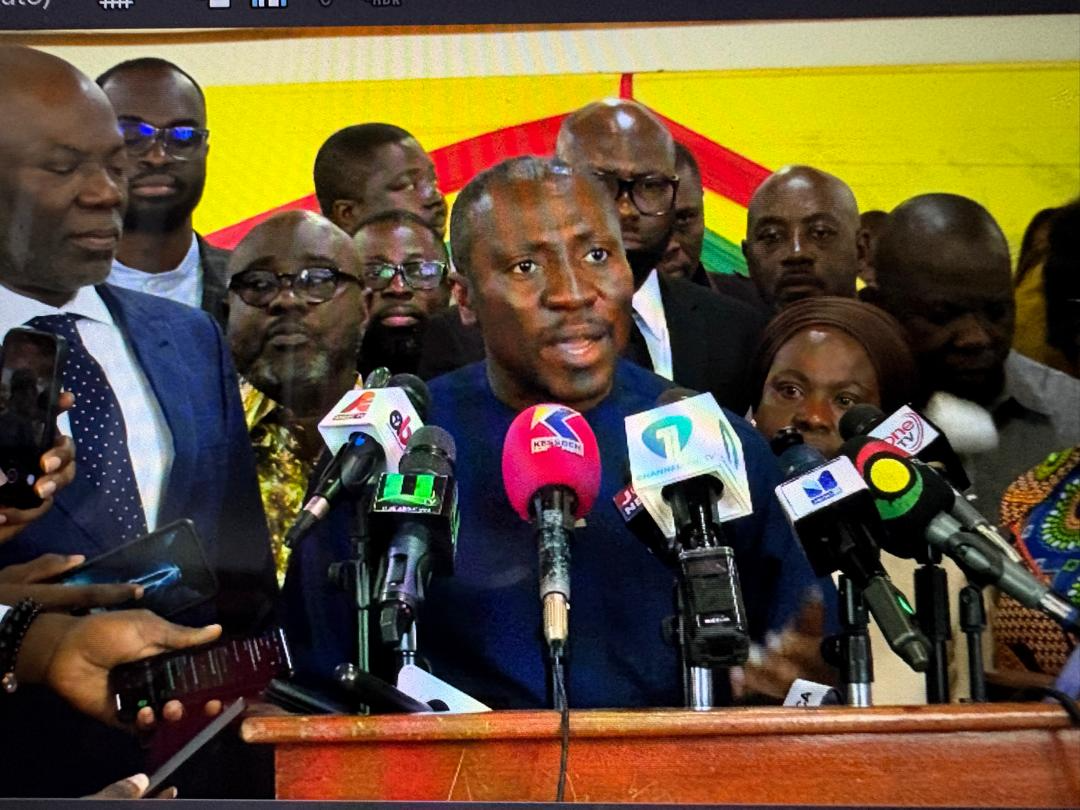
The Minority in Parliament staged a walkout on Wednesday after a dispute over whether its leader could question the Communications Minister about the cost of Ghana’s planned biometric SIM re-registration exercise.
The confrontation began when Minority Leader Alexander Afenyo-Markin sought the financial implications of the new exercise for the government. He raised the issue as a supplementary question after the Minister for Communication, Digital Technology and Innovations, Samuel Nartey George, explained why another registration process was being planned.
Mr Afenyo-Markin said the previous administration had completed a nationwide exercise and asked for the projected public cost of repeating the process. He also requested figures on identities within the existing database that could not be verified.
Mr George told the House that the earlier system contained weaknesses, including biometric records that could not be verified in real time. He said those limitations had allowed stolen or unverified identities to be used in registering SIM cards.
The minister said the proposed exercise would not impose a charge on citizens. Earlier, responding to a question from Fanteakwa South MP Duke William Allen Kwame Amoako-Atta Ofori-Atta, he said the existing registration platform could not support the enhanced requirements for real-time biometric verification.
First Deputy Speaker Bernard Ahiafor, who was presiding, directed the Minority Leader to submit a separate question under parliamentary procedure if he wanted the minister to address the government’s cost.
Mr Afenyo-Markin disputed that direction. He relied on Standing Order 89(1), arguing that the rules permitted supplementary questions arising from a minister’s answer. Because Mr George had already said citizens would not pay, the Minority Leader maintained that a question about who would bear the cost and how much government would spend followed directly from the response.
The disagreement was not resolved on the floor. Minority MPs then left the chamber, accusing the presiding officer of applying the rules in a way that restricted Parliament’s scrutiny of a major national technology policy.
The government’s case for the exercise rests on replacing or upgrading a platform that the minister says is unable to authenticate biometric identities at the required speed and standard. The policy is intended to prevent SIM cards from being connected to stolen identities or records that cannot be confirmed against an authoritative database.

The Minority has not disputed the stated goal of improving identity verification. Its immediate objection concerns the financial and administrative case for a new exercise after the resources used for the previous registration, as well as Parliament’s ability to obtain those details during ministerial questioning.
No amount for the proposed registration was supplied during the exchange. The minister’s assurance addressed charges to individual users but did not state the total public expenditure, the procurement structure, the implementation timetable or the number of existing records requiring new verification.
Those unanswered points remain central to the dispute. The Minority wants the government’s cost and the scale of the database problem placed on the parliamentary record, while the presiding officer’s direction means the cost question may have to return as a formally filed item.
The walkout occurred on the same day the Minority also objected to the format of a separate closed briefing involving the Bank of Ghana Governor. In the SIM registration matter, however, the latest official position remains that citizens will not be charged and that the current platform is considered inadequate for the planned real-time biometric checks.