







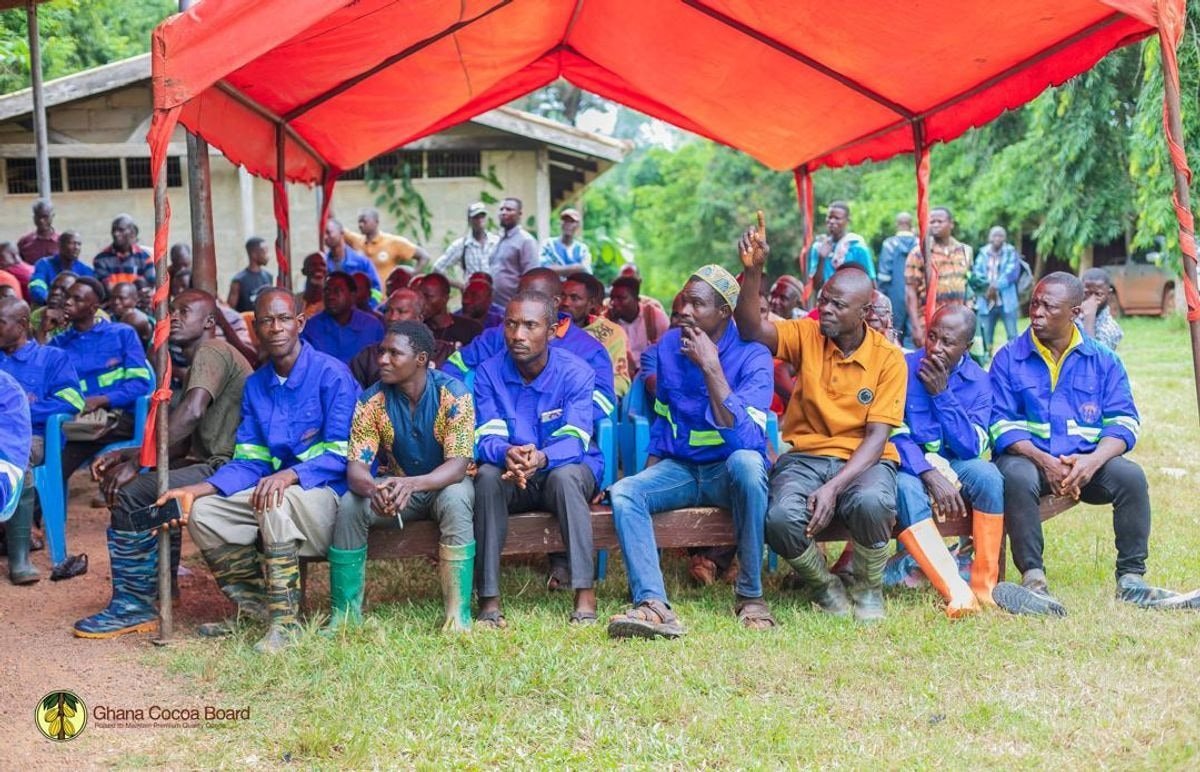
The Ghana Cocoa Board has begun a nationwide campaign to explain the restored Free Fertiliser and Agro-Inputs Distribution Programme and other reforms affecting cocoa farmers.
The sensitisation exercise started in the Western South and Ashanti cocoa-growing regions and is being conducted by COCOBOD’s Public Affairs Department with the Cocoa Diseases and Pest Control Unit of the Cocoa Health and Extension Division.
Officials are explaining eligibility, allocation, distribution and accountability arrangements before farmers receive inputs. The programme replaces a subsidised system with a fully government-funded intervention.
Only registered farmers with productive farms recorded in the Cocoa Management System or other approved records will qualify. Abandoned, moribund and diseased farms, as well as land affected by illegal mining or converted to other uses, are excluded.
Fertiliser allocations will follow scientific agronomic assessments. Productive farms are scheduled to receive three bags of granular fertiliser per acre, subject to a maximum of 10 acres for each farmer.
Younger and mature farms will receive inputs according to their particular requirements. The distinction is intended to align the distribution with the condition and productive stage of each farm rather than issue identical quantities without assessment.
COCOBOD will use 247 decentralised community distribution centres. Community Task Forces will supervise the process and work with beneficiary lists, communal fertiliser application, collection of empty sacks and continuous field monitoring.
The accountability measures are designed to track inputs from delivery to application. Retrieval of empty sacks provides one record that fertiliser reached the intended area and was used under the programme.
Community Task Forces will also use beneficiary lists and field monitoring to compare approved allocations with farms served at each distribution point during implementation.
National Coordinator of the Cocoa Disease and Pest Control programme Seidu Iddrisu Abu said 89,000 sets of personal protective equipment were also being distributed. The items include overalls, wellington boots, gloves, nose masks, hats and goggles.
Spraying gangs are among the recipients, while society chief farmers will receive protective equipment for the first time. The distribution is connected to disease-and-pest-control work in cocoa communities.

COCOBOD Deputy Head of Public Affairs Benjamin Teye Larweh said recent delays in producer payments resulted from financing constraints linked to a sharp fall in international cocoa prices. He said funds had been released to licensed buying companies to settle outstanding payments.
The Board is also preparing a new COCOBOD Bill for parliamentary consideration. Proposed areas include producer-price determination, crop financing, institutional governance and protection of cocoa farms from illegal mining and other threats.
Traceability and sustainability reforms form another part of the campaign. COCOBOD said the measures were intended to meet the European Union Deforestation Regulation, African regional standards and other market requirements.
Compliance is important for maintaining access to markets that require proof concerning the origin and environmental status of cocoa. The sensitisation programme therefore covers both inputs used on farms and information needed within the supply chain.
Farmers will also receive information about a tertiary education scholarship scheme for their children scheduled to begin in the 2026/27 academic year. Eligibility and application details were not fully set out in the initial announcement.
The campaign will move beyond the two starting regions as the national programme proceeds. The immediate phase is focused on making farmers understand the rules before fertiliser and other inputs are distributed through the community centres.