



Ghana’s 2028 general election is more than two years away. The NDC’s presidential primary, under the party’s constitution, is not expected to be held until 2027. President John Dramani Mahama has barely completed eighteen months of his current term. And yet the race to succeed him as the National Democratic Congress’s standard-bearer is already producing polling data, nationwide campaign tours, internal party warnings, and public speculation intense enough to draw in the NDC Council of Elders.
This is not surprising. The NDC has just won a decisive election. It controls the presidency, the majority in parliament, and the machinery of government. For ambitious politicians within the party, the next logical prize is the 2028 presidential ticket, and the early jostling reflects what is at stake. Whoever carries the NDC flag in 2028 will enter the race as the incumbent party’s candidate, with all the structural advantages that brings.
The question the party must answer is not merely who wants it most. It is who the NDC needs.
The Council of Elders Steps In
Before examining the contenders, one development from late May 2026 sets the scene for everything that follows.
The NDC Council of Elders held a high-level meeting with President Mahama on Friday, May 29, 2026, where discussions focused on party unity, internal discipline, and support for the government’s national Reset Agenda. Following the meeting, the Council issued a strongly worded statement expressing concern over reports that some party members and interest groups had already begun engaging in activities associated with presidential campaigns. Oakadept
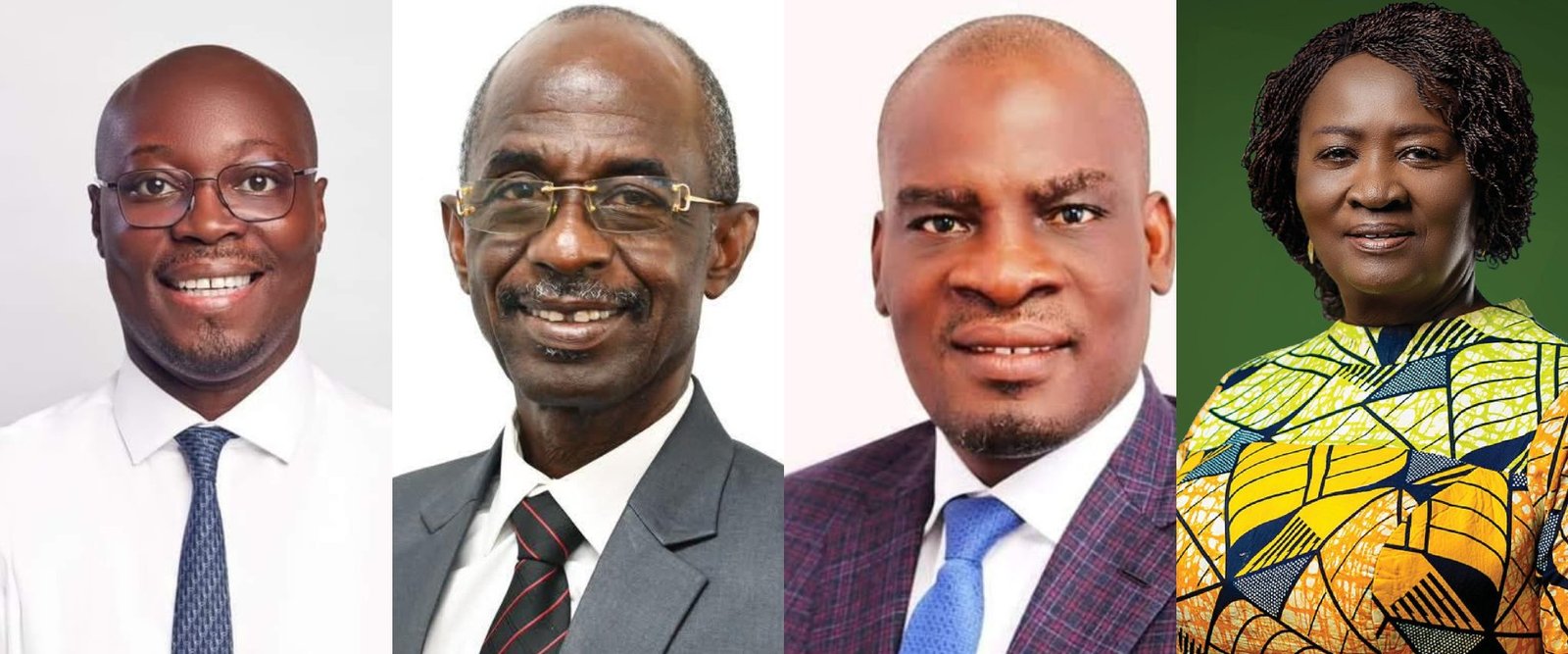
Among those frequently mentioned as active in early positioning are Chief of Staff Julius Debrah, National Chairman Johnson Asiedu Nketiah, Finance Minister Cassiel Ato Forson, Education Minister Haruna Iddrisu, and Agriculture Minister Eric Opoku. The Council reminded party members that the NDC Constitution clearly outlines the process for electing a presidential candidate and that no individual is authorised to campaign until the appropriate constitutional procedures have been activated. OakBags
The Council’s intervention signals two things simultaneously. First, that the race is real and active regardless of the constitutional timetable. Second, that the party’s senior guardians are watching and will not allow internal competition to fracture the unity that delivered the 2024 victory.
That context matters for assessing every candidate. The NDC in 2028 does not just need someone who can win an internal primary. It needs someone who can hold the party together through the process of getting there and still win a national election at the end of it.
The Frontrunners: A Clear Field With One Leader
The polling picture, across multiple surveys conducted between late 2025 and April 2026, is consistent in its top finding even as the specific numbers shift.
The most recent substantive poll of NDC delegates, conducted by Global InfoAnalytics between March 31 and April 9, 2026, covered nearly 10,400 delegates across all sixteen regions using random probability sampling. It places National Chairman Johnson Asiedu Nketiah at 29 percent, ahead of Finance Minister Cassiel Ato Forson at 19 percent. Education Minister Haruna Iddrisu follows with 11 percent, while Chief of Staff Julius Debrah and Vice President Jane Naana Opoku-Agyemang each recorded 8 percent. Twenty-four percent of respondents remain undecided. Centroserve
A separate survey conducted by policy think tank Africa Policy Lens between April 17 and 19, covering 2,408 constituency-level executives across all 276 constituencies, produced a similarly revealing result. The poll placed Asiedu Nketiah leading with 31.9 percent, narrowly ahead of Julius Debrah on 30.1 percent. Haruna Iddrisu followed with 17.9 percent and Cassiel Ato Forson garnered 13 percent. Jane Naana Opoku-Agyemang and Samuel Okudzeto Ablakwa polled 3.6 percent and 1 percent respectively. Tote and Mugs
Two different methodologies. Two different target respondents. One consistent finding: Asiedu Nketiah leads among the delegates who will actually vote in the primary.
Johnson Asiedu Nketiah: The General Who Has Waited the Longest
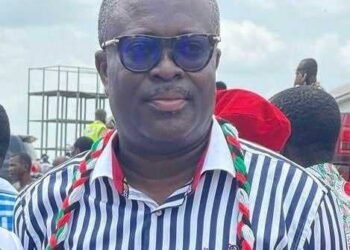
There is no figure in contemporary Ghanaian politics whose career more fully embodies the proposition that persistence is itself a form of strategy. Johnson Asiedu Nketiah, known to Ghana’s political class and the general public as General Mosquito, has served as the NDC’s National Chairman longer than any executive has served in any party under the Fourth Republic.
A former Member of Parliament and minister, Asiedu Nketiah kicked off his political career in the 1980s when few expected him to survive such a difficult terrain for this long. Known for his sharp tongue, strategic wit, and grassroots appeal, he has time and again proven to be a political tactician, often underestimated by rivals but always emerging with a sting. Souvenirs Ghana
His current delegate polling lead is not an accident. It is the harvest of decades of ward-level political cultivation. Asiedu Nketiah’s nationwide Thank You Tour, conducted through late 2025 and into 2026, has been widely hailed as a boost for grassroots engagement and national unity, taking him through every region of the country in a systematic campaign that doubles as presidential positioning. aBibleQuiz
The strategic case for his candidacy rests on three pillars that are distinct from those of any other contender in the field.
The first is organisational depth. No person alive understands the internal mechanics of the NDC, its branches, its constituency structures, its delegate blocs, and its pressure points, better than Asiedu Nketiah. In a party primary decided by delegates rather than the general public, this institutional knowledge is not an abstract advantage. It is the primary competitive asset.
The second is identity politics. Political analysts have noted that Asiedu Nketiah represents a particular balance the NDC has not fielded as its presidential candidate before. He is an Akan, a Christian, and a southerner, three identities that resonate strongly with Ghana’s majority voting blocs. Since 2012, the NDC has consistently presented a northerner as its flagbearer. Fielding a southerner in 2028 would allow the party to position a northerner as running mate, creating a formula that addresses both geographic representation and the desire for fresh electoral calculus. Oakadept
The third is general election viability. A March 2026 tracking analysis by Global InfoAnalytics examining a potential 2028 contest between Asiedu Nketiah and NPP’s likely flagbearer Mahamudu Bawumia found a politically charged equilibrium forming, with the expanding electorate, particularly 2024 non-voters, introducing subtle but consequential shifts in momentum that benefit Asiedu Nketiah. OakBags
His weakness is equally clear. Among general Ghanaian voters in earlier surveys that preceded his Thank You Tour, his numbers were softer than his delegate support suggests. The gap between party popularity and national electability is a question he will need to answer convincingly as the primary approaches.
Julius Debrah: The Quiet Contender With Structural Backing
The most surprising development in the 2028 NDC race is how competitive Julius Debrah has become in the space of a few months. Ghana’s Chief of Staff was not widely discussed as a serious presidential contender twelve months ago. The latest polls suggest he may be the toughest obstacle between Asiedu Nketiah and the ticket.
The Africa Policy Lens survey placed Debrah just 1.8 percentage points behind Asiedu Nketiah among constituency executives, a margin the report described as structurally balanced at the top. On the question of voting preference if elections were held today, Asiedu Nketiah led with 32.7 percent to Debrah’s 30.9 percent. Centroserve
Debrah’s proximity to President Mahama is both his greatest asset and his most significant risk. As Chief of Staff, he controls access and resources that translate into political capital. But any candidate seen as the incumbent’s hand-picked successor runs the risk of being perceived as continuation rather than renewal, a liability in a party that has always prized internal democratic legitimacy. How he manages the balance between presidential favour and independent credibility will define whether he can convert his current polling position into actual delegates. Tote and Mugs
Cassiel Ato Forson: The Economist Making a Move
Dr Cassiel Ato Forson’s rise in the national voter polls through late 2025 and into 2026 reflects the premium that ordinary Ghanaians place on economic competence at a time when the country is still climbing out of a painful financial crisis.
Global InfoAnalytics polling showed Ato Forson rising to 23 percent among general voters in December 2025, buoyed by growing confidence in his economic stewardship as Finance Minister. The pollster noted: “Buoyed by the economy, the poll suggests Ato Forson may have the momentum to lead the party at least judging by general voters’ preferences.” Souvenirs Ghana
His challenge is the inverse of Asiedu Nketiah’s. Where the Chairman leads strongly among delegates but faces questions about national electability, Forson has demonstrated national voter appeal but currently trails significantly among the party insiders who control the primary outcome. If he enters the race formally and campaigns actively, his delegate numbers will likely improve. Whether he can close a ten-percentage-point gap with Asiedu Nketiah at the delegate level before the primary is the central question his candidacy must answer. aBibleQuiz
Haruna Iddrisu: The Northern Pillar With Fading Momentum
Haruna Iddrisu spent much of 2025 as the frontrunner in national voter surveys. The Education Minister and longtime Tamale South MP carries a profile, northern, experienced, politically seasoned, that seemed tailor-made for the post-Mahama NDC in an earlier iteration of this race.
Earlier Global InfoAnalytics surveys had placed Iddrisu at 26 to 30 percent of national voter support, describing him as dominant with wide cross-regional and generational appeal. By December 2025, however, his numbers had slipped to 26 percent and continued a downward trajectory as other candidates solidified their positions. Oakadept
The structural challenge for Iddrisu is demographic. About 64 percent of NDC supporters, including many who backed President Mahama, now favour younger candidates. Iddrisu, Ato Forson, and Ablakwa together account for roughly 65 percent of Mahama’s 2024 voter base in terms of generational preference. But while Iddrisu is counted in the youthful tier, his delegate numbers in the most recent surveys place him third, behind both Asiedu Nketiah and Debrah among the constituency executives who matter most in a primary. Unless there is a dramatic shift, he appears more likely to be a serious running-mate conversation than a flagbearer frontrunner. OakBags
Prof. Jane Naana Opoku-Agyemang: Historic Symbol, Uncertain Pathway
Vice President Jane Naana Opoku-Agyemang occupies a unique position in this conversation. She is not a declared candidate. She holds the second highest office in the land. And in certain polls, particularly those measuring name recognition among general voters, her numbers have been the highest in the field.
Earlier Global InfoAnalytics surveys placed Opoku-Agyemang at 33 percent in general voter preference, well ahead of the field. Her advantage rested on name recognition, her history as the first woman on a major party presidential ticket, and the goodwill she accumulated during the 2020 and 2024 campaigns. Centroserve
Yet when the pollster shifted from general voters to NDC delegates specifically, her numbers collapsed. The most recent delegate poll placed her at 8 percent, tied with Debrah. Among constituency executives in the Africa Policy Lens survey, she polled just 3.6 percent. The gap between her national popularity and her delegate support suggests that while she is admired, she is not the choice of the party machinery.
Her position as Vice President also creates a constitutional and political complexity around any declared candidacy. A sitting Vice President positioning for the party primary would represent an unusual dynamic within the government, one that would require careful management to avoid undermining the administration she currently serves. Tote and Mugs
What the NDC Actually Needs in 2028
Every candidate in this field has a viable argument for why they should carry the flag. The question of what the NDC needs narrows the field considerably.
The party needs a candidate who can win the internal primary without fracturing the base. The Council of Elders intervention in May 2026 signals that a divisive primary is the outcome party guardians fear most. A candidate with deep grassroots roots who can win cleanly and then turn the party’s unified machinery toward the general election is more valuable than a candidate who wins narrowly and spends the campaign period managing internal discontent.
The party needs a candidate who can hold the NDC’s 2024 coalition intact. Mahama won with 56.42 percent of the vote. Replacing him with a candidate who alienates any significant portion of that coalition before polling day is an unacceptable risk. The regional, religious, and demographic balance of the 2028 ticket is therefore not a secondary consideration. It is the primary one.
The party needs a candidate who can survive the NPP’s 2028 attack lines. Bawumia, Kennedy Ohene Agyapong, or whoever the NPP fields will come with a well-resourced campaign and clear opposition research on any NDC candidate. A figure whose record is well known, whose reputation is established, and who has already survived decades of political combat is more resistant to that kind of pressure than a candidate whose national profile is still being built. Souvenirs Ghana
On all three criteria, Asiedu Nketiah’s edge stems from decades of dedication to the NDC, his unmatched organisational skills, and his ability to resonate with both the party base and the ordinary Ghanaian. He may look fragile, but underestimate General Mosquito at your own peril. He is always buzzing where it matters most, in the minds and hearts of the grassroots. The mosquito may be small, but it is ever-present, persistent, and impossible to ignore. aBibleQuiz
The 2028 race is not over. It has barely begun. Debrah is closer than expected. Forson has national momentum. Iddrisu retains a loyal following in the north. Naana carries a symbolic weight that transcends delegate numbers. Any one of them could still alter the trajectory of this contest.
But as of June 2026, one figure sits at the top of delegate polls, leads the grassroots tour circuit, and embodies the institutional memory that the NDC will need to navigate a post-Mahama transition without losing the ground it has taken years to recover. That figure is Johnson Asiedu Nketiah. Whether the party ultimately agrees is a question only the 2027 primary can answer. Oakadept