








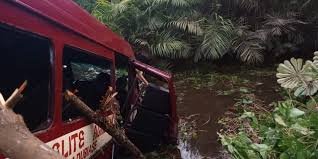
A three-year-old boy and a five-year-old girl are dead. Forty of their classmates are recovering in two hospitals. A Mercedes-Benz Sprinter school bus lies at the bottom of the Kotwea River along the Assin Kwafokrom-Homaho stretch in the Central Region.
The accident happened on the evening of Monday, June 1, 2026. It lasted seconds. The grief it left behind has settled on an entire community, and the questions it raises about school transportation safety in Ghana will not disappear quickly.
What Happened on the Kwafokrom-Homaho Road
Tragedy struck when a school bus transporting more than 40 pupils of Alice Elites Academy, a preparatory school at Assin Edubiase in the Assin South District of the Central Region, veered off the road and plunged into a river.
The deceased, a three-year-old and a five-year-old, were among pupils in the Mercedes-Benz Sprinter bus with registration number AS 2218-20. The accident occurred on the Assin Kwafokrom-Homaho stretch, and the driver reportedly lost control of the vehicle before it veered off the road and plunged into the river.

The children on board were being transported home from school when the bus went off the road. More than 40 of them were on board. The two who died were among the youngest, barely old enough for primary school, still at the kindergarten stage where a child’s world is almost entirely composed of home and the classroom and the short journey between them.
Adom News reported that 40 affected children were rushed to nearby medical facilities immediately after the crash. Twenty-two of the victims were transported to St. Francis Xavier Hospital, while the remaining 18 were taken to the Assin Edubiase Health Centre.
The Police Account
ASP Wonder Lumor of the Motor Traffic and Transport Department of the Central North Regional Police Command confirmed the details to Graphic Online. The 40 injured pupils were transported to health facilities for emergency medical care, with 22 at St. Francis Xavier Hospital and 18 at the Assin Edubiase Health Centre.
Investigations into the precise cause of the crash were ongoing at the time of this report. The MTTD has not yet released a final determination on whether the accident was caused by driver error, a mechanical failure, road conditions, or a combination of factors. The bus involved, a Sprinter registered as AS 2218-20, was the school’s dedicated transport vehicle for pupils in the Assin Edubiase area.

A Community Broken by Grief
The funerals of the two children took place at Assin Kwafokrom in the days following the accident. What unfolded was not a quiet family burial. It became a community event, attended by hundreds of residents from Kwafokrom and surrounding areas.

Hundreds of mourners gathered at the funeral grounds to pay their final respects, with scenes of sorrow and emotional distress dominating the ceremony. Family members were seen weeping uncontrollably as sympathisers consoled them, while schoolchildren in uniforms joined teachers and officials of Alice Elites Academy to mourn their classmates.
The sight of uniformed children mourning classmates who were their own age, or younger, is one that is difficult to put into a news frame without also acknowledging what it means. These were not statistics. They were a three-year-old and a five-year-old who went to school on Monday morning and did not come home.
Residents described the tragedy as devastating, with many still struggling to come to terms with the loss. One community member said: “I panic whenever I wake up. My child was very close to one of the deceased.”
School Transport Safety: A Problem Ghana Has Not Solved
This accident did not occur in a vacuum. It is part of a pattern that has been documented repeatedly and addressed inadequately.
Ghana’s roads are among the most dangerous in West Africa by fatality rate per vehicle. School transport, in particular, operates in an almost entirely informal environment. Most private schools, including preparatory schools like Alice Elites Academy, arrange transport through privately owned minibuses and Sprinter vans rather than purpose-built school buses. These vehicles are subject to standard roadworthiness inspections but are not always subject to the more rigorous safety requirements that dedicated school transport demands, including seatbelts for every passenger, emergency exits, trained drivers with child transport certification, and regular route assessments.
The Assin Kwafokrom-Homaho road is a narrow stretch in the Central Region, not a major highway. But road quality, driver fatigue, vehicle overloading, and the absence of crash barriers on river-adjacent roads are factors that repeat themselves in accident reports across the country, from Assin Fosu to Tamale, year after year.
Ghana’s National Road Safety Authority has periodically called for stricter enforcement of school transport regulations. The calls have not produced the structural reform that the frequency of these accidents demands.
What Needs to Happen

The death of two children aged three and five in a school bus accident is not an unavoidable tragedy. It is a preventable one. Prevention requires specific action: mandatory seatbelts on all school transport vehicles, enforceable maximum passenger limits for school runs, regular MTTD inspections specifically targeting school buses, and criminal accountability for drivers and school operators when negligence is established.
It also requires road infrastructure investment in stretches like Kwafokrom-Homaho, where the absence of barriers between the road and a river means that a driver losing control of a vehicle for even a few seconds can result in children drowning.
At the time of this report, there has been no statement from the Ministry of Education, the National Road Safety Authority, or the Assin South District Assembly specifically in response to the June 1 accident. Ghana News Online has sent enquiries to the MTTD and the school’s management and will update this story when responses are received.
The children of Alice Elites Academy are back in class. Two of their classmates are not. The question Ghana must answer is whether the response to this loss will amount to condolences and silence, or to the kind of concrete action that prevents the next family from going through the same grief.
Ghana News Online will continue to follow this story. Read our full road safety coverage for the latest on Ghana’s efforts to reduce fatalities on the country’s roads.