




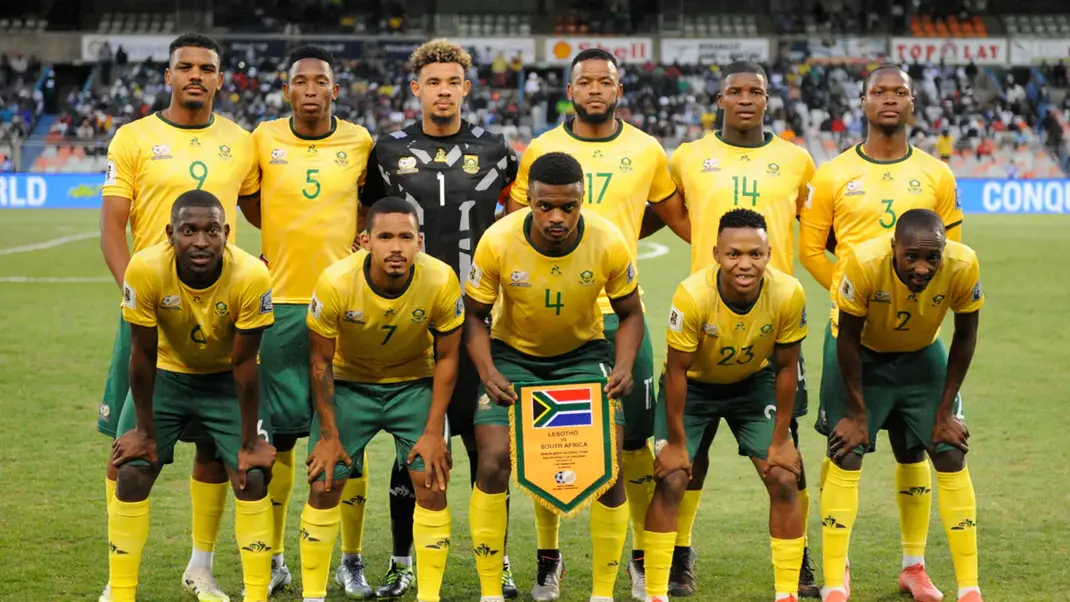
The 2026 FIFA World Cup kicks off today at the Estadio Azteca in Mexico City, where Mexico face South Africa in the tournament’s opening match at 3:00 p.m. Eastern Time. It is a fixture loaded with historical symmetry: sixteen years ago, almost to the day, these same two nations opened the 2010 World Cup in Johannesburg. Siphiwe Tshabalala’s thunderous opener. A united continent roaring. The entire African world watching as one.
Today, the continent is watching again. But this time, significant parts of it are not watching with South Africa. They are watching against it. Oakadept

The Match That Began in Johannesburg and Resumes in Mexico City
South Africa will kick off the 2026 FIFA World Cup with a reverse fixture of the 2010 opener as they face Mexico in Mexico City on Thursday, June 11, precisely 16 years after Siphiwe Tshabalala’s screamer united a nation. OakBags
The 2026 FIFA World Cup officially begins on June 11, 2026, at 3:00 p.m. Eastern Time, when Mexico takes on South Africa at the iconic Estadio Azteca in Mexico City. Mexico City Stadium will become the first venue to host games at three different men’s World Cup tournaments. Centroserve
South Africa are appearing at the World Cup for the first time since 2010, when they drew with Mexico in the opening match but failed to reach the knockout stage. The team’s best performances at the World Cup came during their previous group-stage appearances in 1998, 2002, and 2010, though they were unable to advance beyond the opening round on each occasion, making them the first host nation to be eliminated in the group stage. Currently ranked 60th in the world, Bafana Bafana will look to make history by reaching the knockout stage for the first time. Tote and Mugs
In purely footballing terms, this is a compelling story. A nation returning to the World Cup after a 16-year absence. A famous stadium. A historic rematch. Under any other circumstances, the African continent would be expected to unite behind Bafana Bafana as it did in 2010, when South African fans renamed Ghana’s Black Stars “BaGhana BaGhana” in a gesture of continental solidarity that became one of the most celebrated moments of that tournament.
Those circumstances no longer exist.

Why Ghana, Nigeria, Mozambique, and Others Are Not Cheering for Bafana Bafana
The reason so many African countries are quietly, and in some cases openly, supporting Mexico today has nothing to do with football. It has everything to do with what has been happening on the streets of Johannesburg, Durban, and Cape Town over the past several months.
Mexico is supported today primarily by fans from African countries whose citizens have suffered in one way or another from xenophobia at the hands of South African radical groups in recent months. Anti-immigrant protests have swept through South Africa, with activists demanding that all foreigners without documents leave the country by June 30. Against this background, the governments of Ghana, Nigeria, Mozambique, and several other countries have begun evacuating their citizens, pointing out the threat to their lives and recording new cases of attacks. President Cyril Ramaphosa has been forced to publicly admit that the reputational losses for South Africa are becoming too high and has promised to crack down on radical groups. Souvenirs Ghana
For Ghanaians in particular, this is not an abstract geopolitical grievance. It is personal. More than 1,500 Ghanaians registered to leave South Africa in the past two weeks alone. Three repatriation flights have landed at the Accra International Airport since late May, carrying Ghanaians who watched their businesses looted, their livelihoods stripped away, and in some cases their lives threatened. One man arrived with a bullet in his spine from a hijacking. Two babies arrived without their mothers, who did not survive. Ghana’s Foreign Affairs Minister Ablakwa summoned the South African envoy, issued a formal travel advisory, and petitioned the African Union over what he described as a betrayal of continental solidarity.
Nigeria carries similar wounds. The diplomatic relationship between Abuja and Pretoria has been strained for years by episodes of anti-Nigerian violence in South Africa. The irony is not lost on Nigerians that it was Victor Osimhen’s hat-trick in Nigeria’s 4-0 defeat of Benin Republic in the final qualifier matchday that effectively handed South Africa the Group C ticket to this World Cup. Without that Nigerian result, Bafana Bafana would not be at the Azteca today. Nigeria helped South Africa get here, and South Africa repaid the continent with violence against African migrants. aBibleQuiz
The Political Dimension: South Africa’s Own Sports Minister Set the Tone
The bitterness between African nations and South Africa ahead of this tournament is not confined to street-level grievance. It reached the level of cabinet ministers.
South African Sports Minister Gayton McKenzie, in a remarkable public statement, declared that he wished Nigeria’s Super Eagles would not qualify for the 2026 World Cup through the playoffs, saying: “I want to make it very clear: I wish for them not to qualify. I just want to make that one clear. They tried. I knew what they did behind the scenes for us not to get there. I want them to lose. Another African country must go.” Oakadept
A sitting sports minister, publicly wishing that a fellow African nation fails to qualify for the World Cup, in a tournament that Africa’s qualifying allocation had been expanded to represent. The statement was widely condemned across West Africa and added another layer of resentment to a relationship between South Africa and its continental neighbours that was already badly strained by the xenophobia crisis.
Ahead of the World Cup, a nationalist sentiment has been brewing behind Bafana Bafana in South Africa, particularly online. On a more extreme end, it has unearthed South Africa’s xenophobia and the country’s current dark political mood, demonstrated through debates around defender Ime Okon, whose identity has been interrogated despite being born in South Africa with a South African mother. The politics of belonging that are tearing communities apart on South African streets have followed the team to the Azteca. OakBags

What the Match Looks Like on the Pitch
Stripped of the political context, this is a genuinely competitive fixture.
Hugo Broos’ preparations for the 2026 FIFA World Cup have faced several hiccups, and his side arrives in Mexico City as underdogs. South Africa come off the back of a stale 0-0 draw with Nicaragua in Johannesburg on May 29 and a 1-1 draw with Jamaica in Pachuca on Saturday, a result that left Broos frustrated. Centroserve
Playing the opening match against the host nation is one of the toughest assignments in international football. Mexico enter as hosts backed by vociferous support at the Azteca. Javier Aguirre, in his third stint as Mexico manager, will aim to start well as El Tri look to go deep in the tournament. Despite Mexico keeping six clean sheets in their last eight internationals, five of the last six fixtures involving Bafana Bafana have seen both teams score. Tote and Mugs
If South Africa can withstand early pressure and remain disciplined defensively, they have the tools to make this a far more competitive contest than many expect. Oswin Appollis, one of Bafana’s brightest attacking threats, has the pace and directness to hurt Mexico on the counter. The question is whether a team that has not been at a World Cup for sixteen years, playing away from home in a 87,000-seat stadium against the host nation, can hold its nerve through the opening act of the biggest tournament in football. Souvenirs Ghana
The 2010 Moment and What Has Changed
In 2010, when the World Cup was held on African soil for the first time in history, Tshabalala’s opening goal against Mexico sent a shock of joy through the entire continent. South African fans opened their arms to Ghana’s Black Stars when every other African team was eliminated, naming them BaGhana BaGhana and filling Soccer City to roar them toward the semi-final.
Inside Soccer City, the atmosphere before that Ghana-Uruguay quarter-final felt less like a neutral World Cup match and more like a continental mission. South African journalist Robert Marawa and Ghanaian counterpart Michael Oti Adjei sat together in the charged atmosphere among the 84,017 who packed the stadium that night. That was continental football solidarity at its most genuine and most beautiful. Oakadept
Sixteen years later, the question of whether that solidarity is still intact has been answered, honestly and painfully, by events that have nothing to do with football. Ghana is not rooting against Bafana Bafana because of anything that happens on a pitch. Ghana is watching today’s match through the eyes of every Ghanaian who was forced onto a plane home with nothing left, every family that lost a business built over twenty years to a mob that felt entitled to take it, every baby carried off a plane at Kotoka Airport without a mother. OakBags
The football is real. The history is real. The Azteca is a cathedral of the sport, and today’s match deserves to be celebrated as the opening act of a World Cup that has expanded to 48 teams and spans three nations.

But for much of West and East Africa, the 3:00 p.m. kickoff in Mexico City today carries a meaning that sits well outside the touchlines. When the referee’s whistle sounds, millions of Africans whose governments have been evacuating citizens from South African streets will be watching, and they will not be wearing Bafana Bafana’s yellow and green. Centroserve
What Happens After the Final Whistle
Whether Mexico wins, draws, or loses today, the deeper issue that has brought African nations to this moment of ambivalence will not be resolved by a football result.
President Ramaphosa has publicly admitted that the reputational losses for South Africa from the xenophobia crisis have become too high. His government has promised to crack down on radical anti-immigrant groups. Those promises have been made before. Ghana’s petition to the African Union, scheduled for the mid-year coordination meeting in Egypt later this month, will test whether continental diplomacy can do what bilateral protests have not yet achieved. Tote and Mugs
South Africa and its African neighbours will need to repair this relationship. The continent needs South Africa, and South Africa needs the continent, in ways that run far deeper than football solidarity. The AFCON memories, the 2010 World Cup, and the shared history of the liberation struggle are too significant to be permanently undone by a political moment, however painful.
But today, on the opening day of the 2026 FIFA World Cup, as the vuvuzelas sound for the first time since Johannesburg and the Azteca crowd roars for El Tri, a significant portion of the African continent will be hoping, quietly but firmly, that Bafana Bafana lose. Not out of hatred for South African footballers who carry no personal responsibility for what happens on the streets of their country. But out of grief, solidarity with the displaced, and the very human need for something to express what words and diplomatic notes have not yet fully conveyed. Souvenirs Ghana
Football has always carried Africa’s political emotions. Today is no different.