








Photocopying a Ghana Card, or relying on a visual inspection of it for a transaction, has become a criminal offence under an amendment to the National Identity Register Regulations, 2012. The National Identification Authority says the amendment has been gazetted and that biometric verification is now the lawful route for confirming the identity of a Ghana Card holder in a transaction.

The change moves identity verification away from the long-standing practice of taking or retaining copies of cards. Under the amended rules, an organisation is not to treat a photocopy or a physical look at the card as proof of a person’s identity. It is expected instead to use the NIA biometric verification system. The requirement applies beyond the financial sector, according to the account of the amendment, and affects organisations that use the Ghana Card to establish identity in transactions.
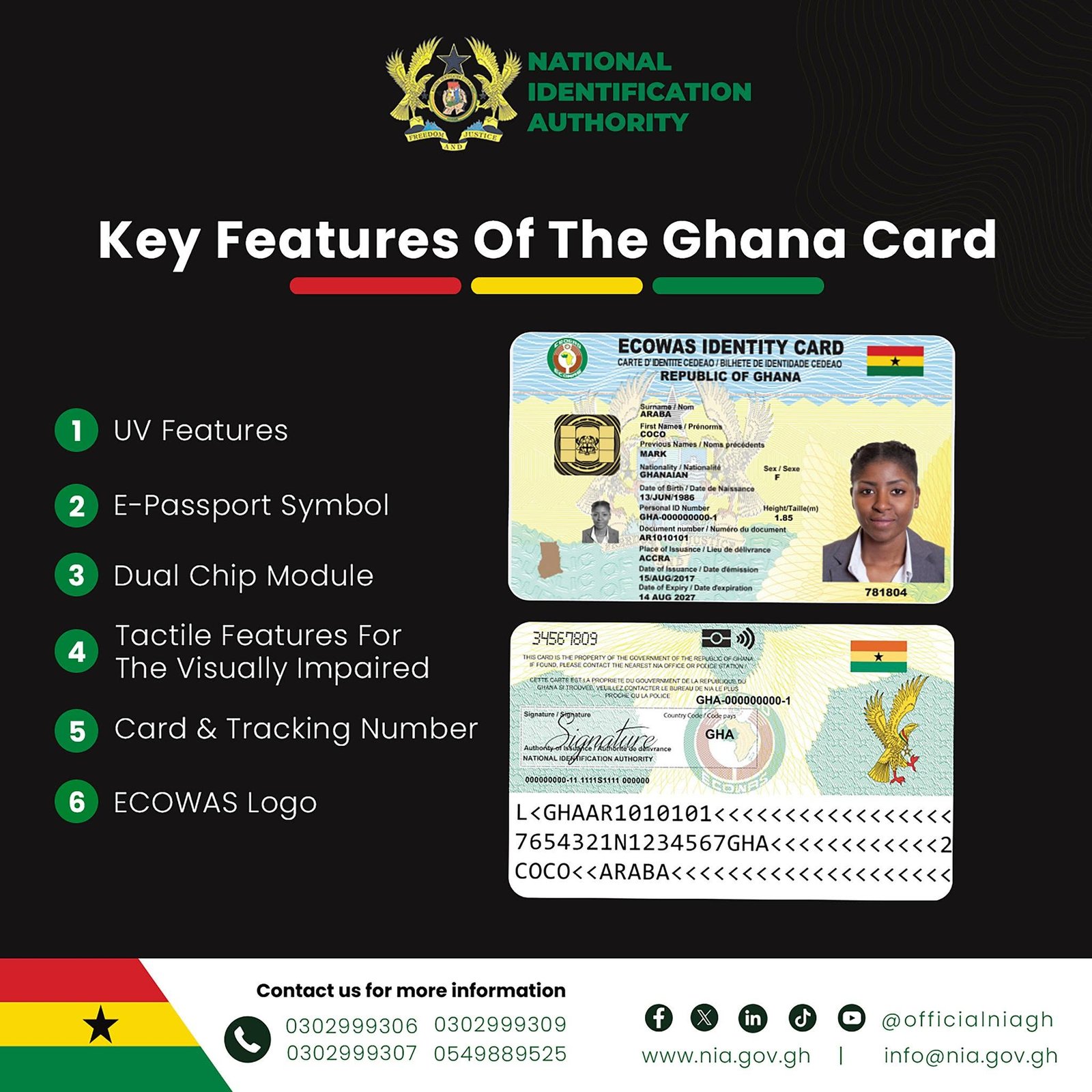
Wisdom Kwaku Deku, the NIA’s Executive Secretary and Chief Executive Officer, announced the gazetting of the amendment on 15 July. The practical consequence is that businesses, institutions and service providers that still request copies of Ghana Cards will need to review their procedures. The report does not set out a transition deadline for entities that are not connected to the verification platform, but it says the NIA has urged such organisations to begin the onboarding process.
The penalties set out in the report differ for institutions and individuals. On the stated penalty-unit value of GH¢12, an institution convicted summarily of contravening the requirement could face a fine of between GH¢6,000 and GH¢24,000. For an individual, the reported range is GH¢600 to GH¢6,000. The figures should be checked against the gazetted instrument before publication because the legal text, rather than a news account, controls the exact offence and sanction.
The amendment follows a sequence of interventions around the use of the Ghana Card. In March 2025, the Bank of Ghana and the NIA met the Ghana Association of Banks and the country’s 25 universal banks on identity-verification requirements. At that meeting, the Bank of Ghana’s Office for Financial Integrity said the central bank had not approved the photocopying of Ghana Cards and warned that the practice could expose customers to fraud. The NIA Legal Directorate also said the card was the legally recognised identification document for banking transactions.
Later, in September 2025, the NIA said it was working on regulations that would introduce sanctions for organisations requesting or copying cards. The authority linked the move to concerns about identity theft. A revised Bank of Ghana supervisory guidance note took effect in October 2025. The report says that guidance requires regulated financial institutions to use the Ghana Card for identification and verification of Ghanaian citizens, permanent residents, resident ECOWAS nationals, refugees and eligible foreign nationals.
That banking guidance also includes biometric liveness checks for people opening accounts through digital channels. It restricts transactions for people who lack a Ghana Card, Non-Citizen Identity Card or Refugee Identity Card, subject to limited exceptions. The new NIA amendment is presented as extending biometric-verification expectations to organisations generally, not merely banks.

The immediate editorial caution is to avoid telling readers that every handling of a Ghana Card is prohibited. The reported prohibition concerns copying or visually inspecting the card for the purpose of a transaction, while the lawful alternative is biometric verification. The public-facing version should therefore describe the conduct precisely, retain the distinction between institutional and individual penalties, and direct readers to the NIA for implementation guidance. It should not state that a person has been convicted or that a particular business is non-compliant unless there is independently verified enforcement action.