







For years it was a campaign promise. Then it became a policy. Then a secretariat. Then a bill. On February 19, 2026, President John Dramani Mahama appended his signature at Jubilee House and made it law. Ghana’s 24-Hour Economy Authority is now a legal reality, backed by legislation, a $110 million budget allocation, and a mandate to restructure how this country produces, trades, and employs its people.
The question Ghana’s business community, investors, and young jobseekers are now asking is not whether the law exists. It does. The question is whether the implementation will match the ambition.
The Signing: What Happened on February 19
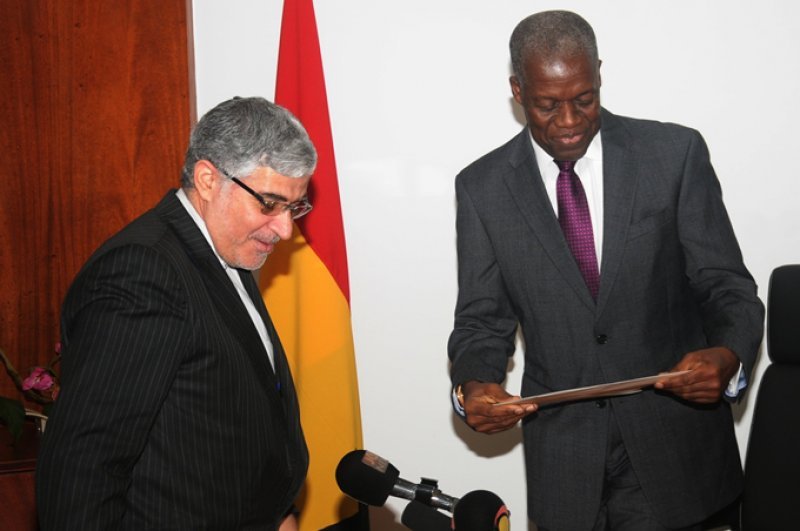
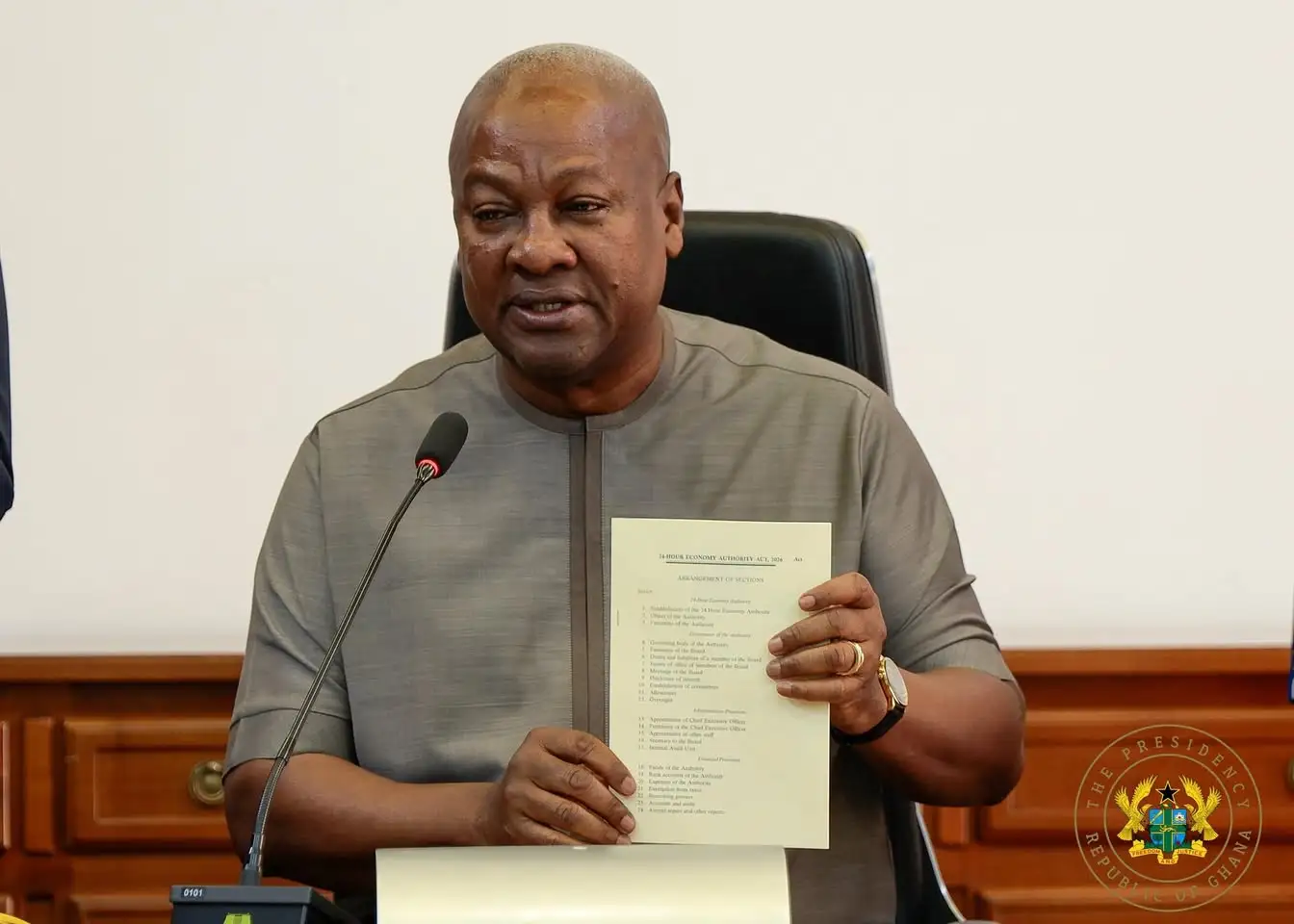
President John Dramani Mahama signed the 24-Hour Economy Authority Bill, 2025 into law on Thursday, February 19, 2026, formally opening the implementation phase of one of his administration’s most prominent economic promises. The assent was given in a brief ceremony at the Jubilee House in Accra, held just before the 13th Cabinet meeting. Presidential Advisor Goosie Tanoh, who led the team that developed the legislation, was present at the signing. Oakadept

The signing ceremony was also witnessed by Vice President Professor Jane Naana Opoku-Agyemang, the Clerk to Parliament Ebenezer Ahumah Djietror, Cabinet Ministers, and Presidential Staffers. The Bill is anchored on three core pillars: Production Systems Development and Transformation; Development of Supply Chain and Market Systems; and Labour Development. OakBags
Speaking shortly after signing the Bill into law, President Mahama said: “I just appended my signature to give assent to the 24-Hour Economy Authority Bill. This Bill Ghanaians have been waiting for. It was one of our flagship strategies for economic transformation. From now, we must move from strategy to implementation. The business sector is waiting, Ghanaian investors are waiting, foreign investors are waiting.” Centroserve
The Road to the Signature: Parliament’s Passage
The bill did not arrive at the President’s desk without contestation. Parliament passed the 24-Hour Economy Authority Bill on Friday, February 6, 2026, following extensive deliberations and intense debate between the Majority and Minority caucuses. The government side argued the policy would significantly boost job creation, productivity, and economic growth, while the Minority raised concerns about potential duplication of existing functions and implementation challenges. Tote and Mugs
Majority Leader Mahama Ayariga, Member of Parliament for Bawku Central, said the legislation was designed to tackle the crisis of youth unemployment and empower the private sector to spearhead job creation. He explained that one of the key pillars of the initiative was Production Systems Development Transformation and Supply Chain Management. Souvenirs Ghana
The Minority’s concerns about duplication were not unreasonable. Ghana already has multiple bodies with overlapping mandates in the investment and industrial development space. The government’s response was to position the 24-Hour Economy Authority not as a replacement for those institutions but as a coordinating body above them, with the legal mandate to align their work toward a single objective: round-the-clock economic activity across the country’s key productive sectors.
What the Authority Is Mandated to Do
The 24-Hour Economy Authority, established by the law as the central coordinating body, is mandated to align public and private sector efforts, mobilise investment, and ensure that infrastructure and regulatory systems are in place to support round-the-clock economic activity. The authority’s operational focus covers manufacturing, agro-processing, logistics, and services, with a particular emphasis on pulling Ghana away from its long-standing dependence on exporting low-value raw materials and importing expensive finished goods. aBibleQuiz
The $110 million allocation announced during the State of the Nation Address will fund the establishment and operations of the new authority, which is tasked with coordinating round-the-clock business activity by incentivising companies to run three shifts instead of the traditional single daytime shift. Oakadept
Cabinet has also approved amendments to the Ghana Investment Promotion Centre Act and the Labour Act to accommodate the new economic model. These changes address worker protections while creating incentives for businesses to extend operational hours. The Ministry of Interior has established a dedicated 24-hour economy policing secretariat to provide continuous security support across the country. Centroserve

Incentives for Businesses: What Is on the Table
The legislation without a compelling incentive package is a framework without fuel. The Mahama administration has been deliberate about attaching tangible benefits to participation.
Speaking at the Kwahu Business Forum, President Mahama outlined a raft of incentives for businesses operating under the 24-hour framework. Businesses registered under the initiative would enjoy duty-free importation of plant and machinery if they expand their operations. Registered companies would also benefit from expedited port services and other logistics facilitations designed to reduce the cost of doing business around the clock. OakBags
The government is moving swiftly to operationalise the policy, including setting up offices and recruiting personnel for the newly established authority. The next phase involves the registration of companies willing to operate under the 24-hour framework, with several companies already running multiple shifts expected to be among the first to sign on. Souvenirs Ghana
When fully set up, organisations interested in the 24-hour economy programme can register and benefit from the incentive packages. The government has made clear that the programme is fundamentally private sector-led, and its success depends on structured collaboration with industry players, investors, and financial institutions rather than government action alone. Tote and Mugs
Early Results: Ports and the Ghana Publishing Company
The policy did not begin with the bill. Ghana launched the 24-Hour Economy nationally in July 2025, giving some institutions a head start on implementation. The early results, where they exist, are encouraging.
Early adopters have already reported measurable benefits. The Ghana Publishing Company Limited recorded a sharp increase in revenue since introducing 24-hour operations, while both Tema and Takoradi ports now operate around the clock, improving trade efficiency and reducing congestion that has historically plagued import and export activity. Oakadept
These are not transformative national statistics yet. They are proof-of-concept data points. The significance is that they exist at all, because Ghana’s track record with industrial policy is littered with initiatives that never moved from announcement to implementation. The ports data in particular carries weight. Tema and Takoradi are the country’s primary commercial gateways. Round-the-clock operations at both facilities represent a structural change in how Ghana handles trade, not a press release.

The Mahama Promise: 1.7 Million Jobs
In his State of the Nation Address on February 27, 2026, President Mahama officially signalled the transition of the 24-Hour Economy policy from a campaign promise to a legal reality. The President declared that the era of strategy has ended and the time for measurable action has begun, formally introducing the 24-Hour Economy Authority as the new statutory body tasked with coordinating round-the-clock operations across manufacturing, services, and agribusiness. aBibleQuiz
The headline jobs figure the government attached to the policy is 1.7 million. That number has not been independently verified and the government has not published a detailed sectoral breakdown showing how it was derived. What is verifiable is the scale of Ghana’s youth unemployment challenge, which makes the ambition both politically necessary and practically urgent. A country where the median age is 21 and where youth unemployment persistently runs above 12 percent in official estimates and considerably higher in practice needs an economic model that can absorb new workers at scale.
Whether the 24-Hour Economy Authority is that model will not be known from the signing ceremony. It will be known from the registration numbers, the shift expansion data, the export volume changes, and the employment figures that the authority is expected to begin publishing once fully operational.
What SMEs Are Saying
Not everyone is ready to work through the night. While large institutions have reported early benefits such as improved service delivery and better infrastructure use, many small and medium-sized enterprises caution that operating around the clock requires significant capital investment in security, energy, logistics, and human resources that most SMEs do not currently have access to. OakBags
Minister of Youth Development and Empowerment George Opare Addo acknowledged the complexity of the transition but said implementation remains on track. “Everyone who is honest will see that the work is meeting expectations,” he stated, adding that complete implementation is realistically expected by the end of 2026. Centroserve

The SME concern is legitimate and deserves a more detailed government response than optimism. The duty-free machinery incentive is meaningful for manufacturers. It is less meaningful for a small food processing company in Kumasi or a printing firm in Takoradi that operates on thin margins and cannot afford the security personnel required to run a night shift safely. The government’s ability to extend the 24-hour economy beyond large institutions and into the SME ecosystem, where the bulk of Ghanaian employment actually sits, will determine whether the 1.7 million jobs target has any realistic basis.
From Strategy to Implementation: The Next Six Months
The 24-Hour Economy Authority exists in law. It has a budget. It has a mandate. It has a secretariat that preceded it and has already begun wooing private sector partners. The implementation timeline the government has given itself runs to the end of 2026.
Ghana’s business community, its diaspora investors, and its young workforce are watching. The bill was the easy part. Governments sign bills. What happens after the signing, whether the offices are staffed, the registrations open, the incentive packages are disbursed, and the shift expansions actually materialise across the country’s productive sectors, is what will determine whether the 24-Hour Economy Authority becomes one of Ghana’s genuine economic turning points or another entry in a long list of well-intentioned legislation that ran out of momentum before it ran out of ink.
President Mahama said it himself at the signing: the business sector is waiting. Souvenirs Ghana